


Nobody Taught Us How to Love. (And Honestly, It Shows.)

The good news: it's a skill. And you're already better at learning things than you think. Let me start with something that should probably be taught in school and somehow never is.
Love — the staying kind, the choosing-each-other-on-a-Wednesday kind — is a skill. Like cooking. Like driving. Like parallel parking, which you also thought you'd never get the hang of, and now you don't even think about it.
Nobody is born knowing how to do this. Not your parents. Not the couple at the dinner party who seem so effortlessly happy. (They're not. They've just had different arguments.) Not you. Not your partner. Not anyone.
We were handed the falling-in-love part — which, let's be honest, is the easy bit, because it mostly just happens TO you — and then left completely alone with the staying-in-love part, which is the actual skill, and considerably harder, and somehow nobody mentioned this at any point.
(Not in school. Not at the wedding. Not even in the very long queue at IKEA, which is arguably when most relationships are truly tested.)
This is not a romantic tragedy. This is just a gap in our education. And gaps in education? Those can be filled.
We Asked One Person to Be Everything. Alain de Botton Has Thoughts.
Philosopher Alain de Botton — who is very funny about this, which helps — points out that we now expect one single person to be our best friend, passionate lover, intellectual sparring partner, co-parent, financial ally, emotional support system, AND adventure companion.
Simultaneously. For decades.
Previous generations distributed these needs across entire villages. Extended families. Communities. We handed the whole lot to one person, called it romance, and then felt quietly ashamed when it turned out to be — occasionally — quite a lot of pressure.
His point isn't that love is impossible. His point is that we've set it up to feel like failure when it requires — gasp — actual effort. And then we assume the effort means something is wrong.
It doesn't. It means you're human. And paying attention. Both good signs.
The Flower Nobody Warned You About
Here's my favourite way to think about this — and I come back to it again and again with clients.
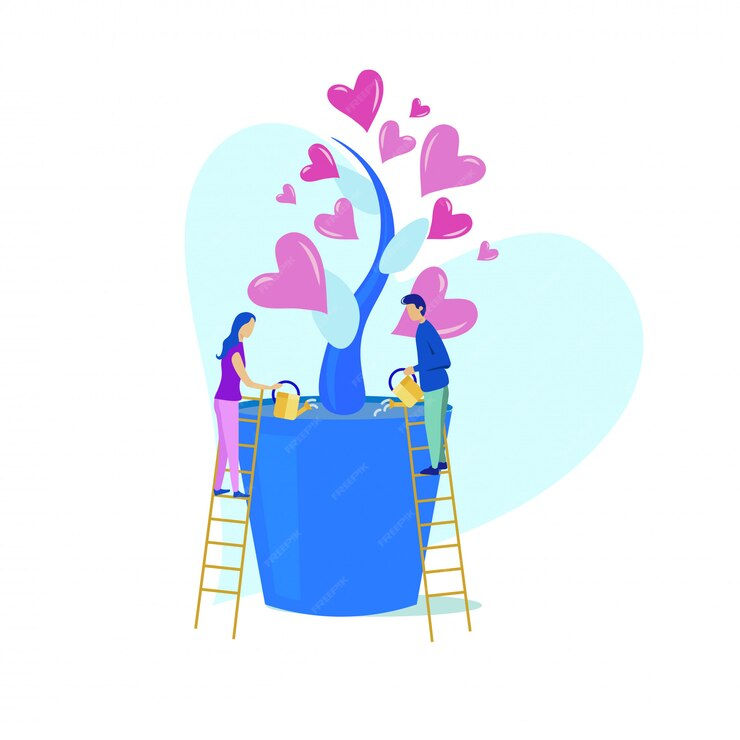
Falling in love is a gift like a flower. You receive it — beautiful, alive, electric, full of possibility. And then — and this is the part nobody mentions at the beginning — you have to tend it. Water it. Give it light. Have the conversation you've been putting off for three weeks. Choose it again, consciously, even on the days when choosing feels harder than it did at the start.
Neglect it long enough and it doesn't make a dramatic exit. It doesn't slam a door. It just quietly stops blooming.
Esther Perel puts it differently but arrives at the same place: "Love is a verb. Something you do." Most of us were just never taught the conjugations.
(And here's the thing: you don't need to be a particularly romantic person to tend a relationship well. You just need to know how. Which — again — is entirely learnable.)
The Argument About the Dishwasher Is Not About the Dishwasher
Dr. John Gottman has spent decades watching couples in his "Love Lab" — yes, that's the actual name, yes it's as charming as it sounds — and figuring out which relationships thrive and which don't.
His finding? The couples who last aren't the ones who never argue. They're the ones who know how to REPAIR after they do.
And underneath most arguments, Dr. Sue Johnson tells us, isn't really the thing you're arguing about. It's a much simpler, much more vulnerable question:
Are you there for me?
The dishwasher. The thing you said at the party. The way you've been distracted lately. These are almost never really about the dishwasher, the thing at the party, or the distraction. They're that question. In disguise. Quite a good disguise, admittedly — but still.
Knowing this changes the argument entirely. Not always in the moment. But eventually.
Knowledge First. Then Understanding. Then Tools.
Here's what I've learned after years of working with couples: awareness alone doesn't change anything. And it's definitely not enough. You need actual skills.
In our work together, every insight gets a practice. Every realisation gets a next step. Because the goal isn't to have a breakthrough in a session and then go home to exactly the same Tuesday.
Over time, your toolbox as a couple grows to include things like: how to have the conversation that actually needs to happen, without it turning into the conversation that always happens. How to repair after a rupture — quickly, genuinely, without a three-day standoff. How to stay curious about each other after years of knowing each other. How to keep desire alive — yes, we go there, cheerfully, because Perel is right that it matters and most couples are quietly relieved when someone finally just says so.
And if you want it — a review date. A point in the calendar where you look back together: what's better? What do we want to try? What do we want to keep?
Because the goal — always — is that you become so good at this, so genuinely skilled at being together, that you don't need me anymore.
That's not a sad ending. That's the whole point.
Knowledge. Understanding. Tools. Independence. Thriving.
So. Where Does That Leave You?
If some part of you is reading this and thinking — yes, but we're actually fine, we just need a tune-up — wonderful. That's the best time to do this work. Before the drift becomes a distance.
If another part of you is reading this and thinking — we might have left it a little long — also fine. Six years is apparently the average. You're in good company. And it's not too late. It's almost never too late, as long as both people are still in the room.
And if you're reading this thinking — I just want to know what's actually possible for us — that's exactly what the first conversation is for.
WINTER PILOT — LIMITED PLACES
A First Conversation. Free. 90 Minutes.
This winter I'm offering a limited number of free 90-minute Relationship Taster Sessions — relaxed, private, no agenda. You talk, I listen. You leave with one real insight and one tool you can actually use.
Not a programme. Not a commitment. Just a genuine beginning — if it feels right.
The session can be held in either German or English.
- Only a handful of places this winter.
- Book your free session: bewellvital.com/free-intro-call-winter-pilot
- Full details: bewellvital.com/winterpilot-individual
Nobody taught us how to love. That part is true.
But you learned to parallel park. You learned to navigate IKEA. You learned approximately forty-seven things this year that you didn't know last year.
You can learn this too.
Be well. Be vital. Be you. —
Heidi Link,
BeWellVital
Disclaimer: Content is for informational purposes only and does not constitute medical advice. Coaching is not a substitute for therapy or medical treatment. © BeWellVital Ltd


Comments